
The density, viscosity and sound velocity for binary mixtures of 1,3-dioxolane + pentanol, 1,3-dioxolane + hexanol, 1,3-dioxolane + heptanol, 1,3-dioxolane + octanol, 1,3-dioxolane + nonanol and 1,3-dioxolane + decanol have been measured at the temperature 298.15 K, are conducted at atmospheric pressure. From these experimental values, various thermodynamic and excess thermodynamic properties were calculated. The adiabatic compressibility (βad), excess adiabatic compressibility (βadE), inter molecular free length (Lf), excess inter molecular free length (LfE), enthalpy (H), excess enthalpy (HE), free volume (Vf), excess free volume (VfE)), internal pressure (Pi), excess internal pressure (piE) have been in vestigated from density (ρ), viscosity (η) and sound velocity (u) measurements of six binary liquid mixtures of 1,3-Dioxolane with pentanol, hexanol, heptanol, octanol, nonanol and decanol over the entire composition range of mole fractions at 298.15K. An excess values of adiabatic compressibility (βadE), inter molecular free length (LfE)), excess enthalpy (HE), excess free volume (LfE) and excess internal pressure (piE) were plotted against the mole fraction of 1,3-dioxolane over the whole composition range. The excess properties are found to be negative depending on the molecular interactions and the nature of the liquid mixtures. The systems studied exhibit very strong cross association through hydrogen bonding.
| Published in | American Journal of Applied Chemistry (Volume 13, Issue 6) |
| DOI | 10.11648/j.ajac.20251306.12 |
| Page(s) | 164-179 |
| Creative Commons |
This is an Open Access article, distributed under the terms of the Creative Commons Attribution 4.0 International License (http://creativecommons.org/licenses/by/4.0/), which permits unrestricted use, distribution and reproduction in any medium or format, provided the original work is properly cited. |
| Copyright |
Copyright © The Author(s), 2025. Published by Science Publishing Group |
Binary Mixtures, Adiabatic Compressibility, Enthalpy, Free Volume, Internal Pressure, Hydrogen Bonding, Molecular Interaction
Component | Formula | CAS Reg. No. | Supplier | Mass Fraction Purity (%) | Method Purity analysis method |
|---|---|---|---|---|---|
1,3-Dioxolane | C3H6O2 | 646-06-0 | CDH New Delhi | 99.7 | Chromatography by the supplier |
Pentanol | C5H12O | 71-41-0 | CDH New Delhi | 99.7 | Chromatography by the supplier |
Hexanol | C6H14O | 111-27-3 | CDH New Delhi | 99.5 | Chromatography by the supplier |
Heptanol | C7H16O | 111-70-6 | CDH New Delhi | 99 | Chromatography by the supplier |
Octanol | C8H18O | 111-87-5 | CDH New Delhi | 99.7 | Chromatography by the supplier |
Nonanol | C9H20O | 143-08-8 | CDH New Delhi | 99 | Chromatography by the supplier |
Decanol | C10H22O | 112-30-1 | CDH New Delhi | 99 | Chromatography by the supplier |
Compound | ρ (g.cm-3) | u (m.s-1) | η (mPa s) | |||
|---|---|---|---|---|---|---|
Observed | Literature | Observed | Literature | Observed | Literature | |
1,3-Dioxolane | 1.0616 | 1.0577 [17] | 1340 | 1338 [17] | 0.5885 | 0.5878 [17] |
1.0586 [17] | 1338 [18] | 0.5873 [17] | ||||
Pentanol | 0.8124 | 0.8108 [13] | 1198 | 1197 [16] | 3.3978 | 3.5411 [13] |
0.8107 [13] | 1268 [22] | 3.5424 [13] | ||||
Hexanol | 0.8176 | 0.8187 [13] | 1306 | 1304 [15] | 4.6091 | 4.5924 [ 8] |
0.8152 [15] | 1303 [15] | 4.5932 [20] | ||||
Heptanol | 0.8196 | 0.8187 [13] | 1325 | 1327 [15] | 5.9066 | 5.9443 [13] |
0.8197 [19] | 1327 [ 23] | 5.9443 [2 3] | ||||
Octanol | 0.8236 | 0.8216 [13] | 1350 | 1348 [14] | 7.1508 | 7.6605 [13] |
0.8218 [13] | 1347 [22] | 7.5981 [13] | ||||
Nonanol | 0.8248 | 0.8244 [15] | 1366 | 1365 [15] | 8.9258 | 9.0230 [21] |
0.8242 [15] | 1364 [ 23] | 9.0200 [ 23] | ||||
Decanol | 0.8292 | 0.8267 [15] | 1378 | 1380 [15] | 11.8027 | 11.825 [15] |
0.8264 [19] | 1379 [ 23] | 11.829 [15] | ||||
Mole fraction 1,3-Dioxolane (x1) | Density (ρ) / g.cm-3 | Sound velocity (u) / ms-1 | Viscosity (η) / mPas. | Intermolecular free length (Lf) ×10-4/m | adiabatic compressibility ×10-7/ Pa-1 | Internal pressure (Pi) ×109/Nm-2 | Free Volume (Vf) ×10-7 M3mol-1 | Enthalpy (H) ×106 |
|---|---|---|---|---|---|---|---|---|
1,3-Dioxolane + Pentanol | ||||||||
0.0000 | 0.8124 | 1198 | 3.3978 | 2.6732 | 8.5770 | 2.9099 | 1.9568 | 0.3156 |
0.0939 | 0.8276 | 1284 | 2.3973 | 2.2842 | 7.3290 | 3.2892 | 3.5817 | 0.3450 |
0.1942 | 0.8436 | 1290 | 1.8970 | 2.2201 | 7.1233 | 3.3763 | 4.9996 | 0.3468 |
0.2941 | 0.8640 | 1296 | 1.4437 | 2.1477 | 6.8909 | 3.4821 | 9.9265 | 0.3384 |
0.3942 | 0.8836 | 1300 | 1.1866 | 2.0872 | 6.6966 | 3.5776 | 11.0374 | 0.3341 |
0.4787 | 0.9068 | 1304 | 1.0904 | 2.0213 | 6.4853 | 3.6885 | 10.8499 | 0.33.8 |
0.5999 | 0.9316 | 1310 | 0.9311 | 1.9495 | 6.2551 | 3.8155 | 13.4125 | 0.3262 |
0.6972 | 0.9596 | 1318 | 0.7717 | 1.8697 | 5.9991 | 3.9663 | 17.4788 | 0.3236 |
0.7928 | 0.9876 | 1324 | 0.7171 | 1.8003 | 5.7762 | 4.1099 | 17.4788 | 0.3201 |
0.9035 | 1.0260 | 1332 | 0.6489 | 1.7121 | 5.4934 | 4.3085 | 19.1422 | 0.3166 |
1.0000 | 1.0616 | 1340 | 0.5885 | 1.6350 | 5.2460 | 4.4982 | 21.7624 | 0.3135 |
1,3-Dioxolane+Hexanol | ||||||||
24.74130 | 0.8176 | 1306 | 4.6091 | 2.2349 | 7.1709 | 3.3333 | 1.7591 | 0.4163 |
0.0912 | 0.8252 | 1317 | 3.3826 | 2.1775 | 6.9867 | 3.4069 | 2.7275 | 0.4112 |
0.1955 | 0.8432 | 1320 | 2.3306 | 2.1214 | 6.8065 | 3.4931 | 4.5760 | 0.4003 |
0.2923 | 0.8584 | 1322 | 1.9839 | 2.0775 | 6.6657 | 3.5642 | 5.5951 | 0.3899 |
0.3982 | 0.8792 | 1325 | 1.5720 | 2.0192 | 6.4786 | 3.6629 | 7.5845 | 0.3787 |
0.4942 | 0.8992 | 1327 | 1.3059 | 1.9619 | 6.3154 | 3.7548 | 9.5968 | 0.3683 |
0.6059 | 0.9264 | 1330 | 1.0343 | 1.9019 | 6.1024 | 3.8815 | 12.9396 | 0.3567 |
0.6976 | 0.9508 | 1332 | 0.9131 | 1.8475 | 5.9279 | 3.9927 | 14.9307 | 0.465 |
0.8018 | 0.9836 | 1335 | 0.7680 | 1.7779 | 5.7045 | 4.1444 | 18.3980 | 0.3352 |
0.8914 | 1.0168 | 1337 | 0.7304 | 1.7147 | 5.5018 | 4.2939 | 18.9465 | 0.3254 |
1.0000 | 1.0616 | 1340 | 0.5885 | 1.6350 | 5.2460 | 4.4982 | 21.7624 | 0.3135 |
1,3-Dioxolane+Heptanol | ||||||||
0.0000 | 0.8196 | 1325 | 5.9066 | 2.1660 | 6.9497 | 3.4147 | 1.5030 | 0.4838 |
0.0928 | 0.8304 | 1334 | 4.3181 | 2.1091 | 6.7671 | 3.4949 | 2.3075 | 0.4725 |
0.1905 | 0.8412 | 1334 | 3.2577 | 2.0820 | 6.6802 | 3.5404 | 3.3296 | 0.4552 |
0.2939 | 0.8592 | 1335 | 2.5895 | 2.0353 | 6.5304 | 3.6202 | 4.4224 | 0.4373 |
0.3894 | 0.8740 | 1335 | 1.9926 | 2.0009 | 6.4199 | 3.6826 | 6.1746 | 0.4201 |
0.4818 | 0.8916 | 1336 | 1.5315 | 1.9584 | 6.2837 | 3.7609 | 8.6425 | 0.4042 |
0.6021 | 0.9184 | 1337 | 1.2190 | 1.8984 | 6.0912 | 3.8784 | 11.2315 | 0.3835 |
0.6952 | 0.9420 | 1337 | 1.0959 | 1.8509 | 5.9387 | 3.9780 | 12.3322 | 0.3667 |
0.7892 | 0.9756 | 1338 | 0.9903 | 1.7845 | 5.7255 | 4.1245 | 13.4017 | 0.3505 |
0.9006 | 1.0156 | 1339 | 0.7057 | 1.7116 | 5.4918 | 4.2985 | 20.4381 | 0.3309 |
1.0000 | 1.0616 | 1340 | 0.5885 | 1.6350 | 5.2460 | 4.4982 | 21.7624 | 0.3135 |
1,3-Dioxolane+Octanol | ||||||||
0.0000 | 0.8296 | 1350 | 7.1508 | 2.0764 | 6.6622 | 3.5546 | 1.3767 | 0.5619 |
0.0885 | 0.8296 | 1350 | 5.6095 | 2.0614 | 6.6139 | 3.5585 | 1.8692 | 0.5363 |
0.1967 | 0.8464 | 1349 | 3.9321 | 2.0235 | 6.4923 | 3.6225 | 2.9529 | 0.5100 |
0.2998 | 0.8560 | 1348 | 3.2616 | 2.0038 | 6.4291 | 3.6596 | 3.6234 | 0.4845 |
0.3902 | 0.8712 | 1348 | 2.4284 | 1.9688 | 6.3168 | 3.7245 | 5.2656 | 0.4629 |
0.4963 | 0.8876 | 1348 | 1.9058 | 1.9324 | 6.2002 | 3.7947 | 6.9577 | 0.4375 |
0.6008 | 0.9140 | 1347 | 1.3631 | 1.8794 | 6.0301 | 3.9032 | 10.5160 | 0.4117 |
0.6925 | 0.9340 | 1348 | 1.1376 | 1.8364 | 5.8921 | 3.9930 | 12.7180 | 0.3905 |
0.7975 | 0.9676 | 1348 | 0.9141 | 1.7726 | 5.6875 | 4.1367 | 15.9753 | 0.3652 |
0.8940 | 1.0104 | 1348 | 0.7652 | 1.6975 | 5.4466 | 4.3197 | 18.9060 | 0.3421 |
1.0000 | 1.0616 | 1340 | 0.5885 | 1.6350 | 5.2460 | 4.4982 | 21.7624 | 0.3135 |
1,3-Dioxolane+Nonanol | ||||||||
0.0000 | 0.8248 | 1366 | 8.9258 | 2.0251 | 6.4976 | 3.5970 | 1.1714 | 0.6291 |
0.0876 | 0.8336 | 1366 | 6.8601 | 2.0037 | 6.4289 | 3.6354 | 1.6286 | 0.6020 |
0.1913 | 0.8404 | 1363 | 5.8531 | 1.9963 | 6.4051 | 3.6530 | 1.8990 | 0.5684 |
0.2942 | 0.8504 | 1359 | 4.4022 | 1.9844 | 6.3671 | 3.6802 | 2.6620 | 0.5347 |
0.3963 | 0.8692 | 1355 | 3.1558 | 1.9529 | 6.2662 | 3.7449 | 3.9924 | 0.5014 |
0.4959 | 0.8844 | 1352 | 2.3340 | 1.9279 | 6.1859 | 3.7978 | 5.7014 | 0.4697 |
0.6050 | 0.9092 | 1349 | 1.7321 | 1.8837 | 6.0439 | 3.8913 | 7.9725 | 0.4354 |
0.6947 | 0.9332 | 1346 | 1.3334 | 1.8434 | 5.9145 | 3.9807 | 10.6902 | 0.4072 |
0.7993 | 0.9648 | 1343 | 0.9642 | 1.7910 | 5.7466 | 4.1018 | 15.3683 | 0.3744 |
0.9013 | 1.0084 | 1340 | 0.8031 | 1.7213 | 5.5228 | 4.2372 | 17.3683 | 0.3402 |
1.0000 | 1.0616 | 1340 | 0.5885 | 1.6350 | 5.2460 | 4.4982 | 21.7624 | 0.3135 |
1,3-Dioxolane+Decanol | ||||||||
0.0000 | 0.8292 | 1378 | 11.8027 | 1.9794 | 6.4976 | 3.6639 | 0.8971 | 0.6990 |
0.0881 | 0.8364 | 1374 | 8.5615 | 1.9638 | 6.4289 | 3.6797 | 1.3454 | 0.6634 |
0.191 | 0.8396 | 1370 | 7.8207 | 1.9578 | 6.4051 | 3.6977 | 1.4040 | 0.6226 |
0.2921 | 0.8560 | 1366 | 5.5340 | 1.9413 | 6.3671 | 3.7331 | 2.1400 | 0.5827 |
0.3937 | 0.8672 | 1362 | 4.2319 | 1.9374 | 6.2662 | 3.7654 | 2.8863 | 0.5429 |
0.4956 | 0.8824 | 1358 | 3.4173 | 1.9153 | 6.1859 | 3.8145 | 3.5598 | 0.5035 |
0.604 | 0.9076 | 1353 | 2.5370 | 1.8759 | 6.0439 | 3.9018 | 4.8971 | 0.4615 |
0.7129 | 0.9308 | 1348 | 1.5262 | 1.8427 | 5.9145 | 3.9793 | 9.1301 | 0.4198 |
0.7983 | 0.9616 | 1344 | 1.1637 | 1.7943 | 5.7466 | 4.0927 | 12.1810 | 0.3871 |
0.8971 | 1.0040 | 1340 | 0.8623 | 1.7288 | 5.5228 | 4.2541 | 16.4668 | 0.3505 |
1.0000 | 1.0616 | 1340 | 0.5885 | 1.6350 | 5.246 | 4.4982 | 21.7624 | 0.3135 |
Mole fraction 1,3-Dioxolane (x1) | Excess adiabatic compressibility×10-7/ Pa-1 | Excess intermolecular free length ×10-4/m | Excess Free Volume×10-7M3mol-1 | Excess Internal pressure ×109/Nm-2 | Excess Enthalpy HE×106 |
|---|---|---|---|---|---|
1,3-Dioxolane + Pentanol | |||||
0.0000 | 0.0000 | 0.0000 | 0.0000 | 0.0000 | 0.0000 |
0.0939 | -0.0782 | -0.0115 | -0.5145 | -0.0630 | -0.0165 |
0.1942 | -0.1248 | -0.0515 | -1.2381 | -0.0879 | -0.0224 |
0.2941 | -0.1467 | -0.0802 | -1.8168 | -0.1151 | -0.0264 |
0.3942 | -0.2136 | -0.1767 | -2.4698 | -0.1616 | -0.0283 |
0.4787 | -0.2487 | -0.1849 | -2.5138 | -0.2183 | -0.0302 |
0.5999 | -0.2260 | -0.1709 | -2.2127 | -0.1972 | -0.0281 |
0.6972 | -0.1823 | -0.0997 | -1.7633 | -0.1609 | -0.0264 |
0.7928 | -0.1603 | -0.0798 | -1.2781 | -0.1192 | -0.0216 |
0.9035 | -0.0857 | -0.0231 | -0.7801 | -0.0764 | -0.0189 |
1.0000 | 0.0000 | 0.0000 | 0.0000 | 0.0000 | 0.0000 |
1,3-Dioxolane+Hexanol | |||||
0.0000 | 0.0000 | 0.0000 | 0.0000 | 0.0000 | 0.0000 |
0.0912 | -0.07423 | -0.0127 | -1.1275 | -0.0526 | -0.0142 |
0.1955 | -0.1874 | -0.037 | -1.8761 | -0.0679 | -0.024 |
0.2923 | -0.1345 | -0.0795 | -2.8817 | -0.1096 | -0.0306 |
0.3982 | -0.197 | -0.1632 | -3.3261 | -0.1543 | -0.0333 |
0.4942 | -0.2321 | -0.198 | -3.7201 | -0.2042 | -0.0328 |
0.6059 | -0.2147 | -0.1825 | -3.3444 | -0.1876 | -0.0306 |
0.6976 | -0.1987 | -0.0971 | -2.8519 | -0.1632 | -0.0269 |
0.8018 | -0.1524 | -0.069 | -1.789 | -0.1229 | -0.0233 |
0.8914 | -0.0914 | -0.0245 | -0.830 | -0.0878 | -0.0157 |
1.0000 | 0.0000 | 0.0000 | 0.0000 | 0.0000 | 0.0000 |
1,3-Dioxolane+Heptanol | |||||
0.0000 | 0.0000 | 0.0000 | 0.0000 | 0.0000 | 0.0000 |
0.0928 | -0.0685 | -0.0176 | -1.3519 | -0.0603 | -0.0134 |
0.1905 | -0.1745 | -0.0472 | -2.615 | -0.0807 | -0.0204 |
0.2939 | -0.1426 | -0.0854 | -3.9103 | -0.1129 | -0.0255 |
0.3894 | -0.189 | -0.1717 | -4.3773 | -0.1540 | -0.0281 |
0.4818 | -0.2367 | -0.1842 | -4.4567 | -0.2258 | -0.0305 |
0.6021 | -0.2203 | -0.1791 | -4.2632 | -0.2087 | -0.0282 |
0.6952 | -0.2004 | -0.0944 | -3.3260 | -0.1754 | -0.0253 |
0.7892 | -0.1766 | -0.0776 | -2.4409 | -0.1453 | -0.0211 |
0.9006 | -0.0765 | -0.0238 | -1.4933 | -0.0920 | -0.0155 |
1.0000 | 0.0000 | 0.0000 | 0.0000 | 0.0000 | 0.0000 |
1,3-Dioxolane+Octanol | |||||
0.0000 | 0.0000 | 0.0000 | 0.0000 | 0.0000 | 0.0000 |
0.0885 | -0.077 | -0.01241 | -1.575 | -0.0835 | -0.0136 |
0.1967 | -0.109 | -0.0439 | -3.6097 | -0.1177 | -0.0195 |
0.2998 | -0.192 | -0.0797 | -4.7580 | -0.1779 | -0.0229 |
0.3902 | -0.207 | -0.1646 | -5.6279 | -0.1983 | -0.0271 |
0.4963 | -0.241 | -0.1751 | -6.0149 | -0.2282 | -0.0299 |
0.6008 | -0.219 | -0.1682 | -5.5981 | -0.2183 | -0.0289 |
0.6925 | -0.211 | -0.0967 | -4.6387 | -0.2150 | -0.0251 |
0.7975 | -0.155 | -0.0742 | -3.0346 | -0.1704 | -0.0214 |
0.8940 | -0.051 | -0.0257 | -1.3586 | -0.0785 | -0.0144 |
1.0000 | 0.0000 | 0.0000 | 0.0000 | 0.0000 | 0.0000 |
1,3-Dioxolane+Nonanol | |||||
0.0000 | 0.0000 | 0.0000 | 0.0000 | 0.0000 | 0.0000 |
0.0876 | -0.071 | -0.0128 | -1.6075 | -0.0705 | -0.0115 |
0.1913 | -0.147 | -0.0458 | -3.781 | -0.1168 | -0.0163 |
0.2942 | -0.238 | -0.0741 | -5.4436 | -0.1819 | -0.0225 |
0.3963 | -0.265 | -0.1685 | -6.5197 | -0.2092 | -0.0246 |
0.4959 | -0.309 | -0.1863 | -7.1582 | -0.2461 | -0.0268 |
0.6050 | -0.304 | -0.1796 | -7.0586 | -0.2209 | -0.0247 |
0.6947 | -0.286 | -0.0993 | -5.9552 | -0.1924 | -0.0226 |
0.7993 | -0.249 | -0.0777 | -3.6424 | -0.1555 | -0.0193 |
0.9013 | -0.153 | -0.0378 | -1.6685 | -0.1121 | -0.0144 |
1.0000 | 0.0000 | 0.0000 | 0.0000 | 0.0000 | 0.0000 |
1,3-Dioxolane+Decanol | |||||
0.0000 | 0.0000 | 0.0000 | 0.0000 | 0.0000 | 0.0000 |
0.0881 | -0.0794 | -0.01247 | -1.6524 | -0.0977 | -0.0164 |
0.191 | -0.2059 | -0.0642 | -4.0473 | -0.1456 | -0.0275 |
0.2921 | -0.2325 | -0.0725 | -5.7219 | -0.1745 | -0.0374 |
0.3937 | -0.3002 | -0.1936 | -7.4983 | -0.2269 | -0.0431 |
0.4956 | -0.3418 | -0.2066 | -9.1545 | -0.2630 | -0.0442 |
0.604 | -0.3352 | -0.1905 | -8.4018 | -0.2560 | -0.0421 |
0.7129 | -0.3492 | -0.1188 | -5.7655 | -0.2294 | -0.0371 |
0.7983 | -0.2882 | -0.0741 | -3.7509 | -0.1972 | -0.0284 |
0.8971 | -0.1873 | -0.0584 | -1.8209 | -0.1583 | -0.0186 |
1.0000 | 0.0000 | 0.0000 | 0.0000 | 0.0000 | 0.0000 |
ρ | Densities of Liquid |
u | Ultrasonic Velocity |
| Viscosity |
X1 | Mole Fraction of 1,3-Dioxolane |
T | Temperature |
(βad) | Adiabatic Compressibility |
() | Excess Adiabatic Compressibility |
(Lf) | Inter Molecular Free Length |
() | Excess Inter Molecular Free Length |
(H) | Enthalpy |
(HE) | Excess Enthalpy |
(Vf) | Free Volume |
| Excess Free Volume, |
(Pi) | Internal Pressure |
| Excess Internal Pressure |
𝑌𝐸 | Thermodynamic Excess Function |
| [1] | M. N. Roy, A. Choudhury, and A. Sinha, J. Teach. Res. Chem. 11, 12 (2004). |
| [2] | D. K. Hazra, M. N. Roy, and B. Das, Indian J. Chem. Techno. 1, 93 (1994). |
| [3] | M. N. Roy and A. Choudhury, J. Teach. Res. Chem. 1, 17 (2000). |
| [4] | M. N. Roy, B. B. Gurung, and A. Choudhury, J. Indian Chem. Soc. 81, 1 (2004). |
| [5] | S. L. Oswal and H. S. Desai, Fluid Phase Equilib. 161, 191 (1999). |
| [6] | S. L. Oswal and H. S. Desai, Fluid Phase Equilib. 186, 81 (2001). |
| [7] | R. Palani, S. Saravanan and R. Kumar, Ultrasonic studies on some ternary organic liquid mixtures at 303, 308 and 313K, Rasayan J. Chem., 2(3), 622-629, (2009). |
| [8] | D. K. Sharma, A. K. Trivedi and C. P. Prajapati, An Ultrasonic Exploration of Physico-chemical Properties for Mixtures of Cyclic Diether (1,3-dioxolane) with 1-alkanols (C5-C10) at 298.15K. American Journal of Physical Chemistry, 14(3), 51-62,(2025). |
| [9] | D. K. Sharma and Seema Agarwal, Viscosities and excess thermodynamic properties of binary liquid mixtures of cyclic ether with 1-alkanols at 303.15K. American Journal of Engineering Research (AJER), 14(7), 59-69, 2025. |
| [10] | D. K. Sharma, S. Kumar and A. Khan, Analysis of Thermo Physical Properties of Binary Liquid Mixtures Containing Cyclic Diether with n-Alkanols (C5-C10) at 298.15 K: By Ultrasonic Velocity Measurements. Open Journal of Physical Chemistry, 15(2), 27-39, 2025. |
| [11] | M. F. Bolotnikov, Y. A. Neruchev, V. N. Melikhov, Verveyko and M. V. Verveyko, Temperature dependence of the speed of sound, densities and isentropic compressibility of hexane + hexadecane in the range of (293.15 to 373.15) K, J. Chem. Eng. Data, 50, 1095-1098, (2005). |
| [12] | C. Vallés, E. Pérez, A. M. Mainar, J. Santafé and M. Domínguez, Excess enthalpy, density, speed of sound, and viscosity for 2-methyltetrahydrofuran + 1-butanol at (283.15, 298.15, and, 313.15) K”, J. Chem. Eng. Data, 51, 1105–1109, (2006). |
| [13] | A. H. Zainab, T. A. Al-Dulaimy, Dhafir, Al-Heetim, Husam Saleem Khalaf and Abbas, Ahmed Mohammed, Excess molar quantities of binary mixture of dipropyl amine with aliphatic alcohols at 298.15 K. Oriential Journal of Chemistry, 34(4), 2074-208, (2018). |
| [14] | G. P. Dubey and Monika Sharma, Excess volumes, densities, speed of sound and viscosities for the binary systems of 1-Octanol with hexadecane and squalane at (298.15, 303.15 and 308.15)K. Int. J Thermo phys. 24, 1361-1375, (2008). |
| [15] | J. A. Al-Kandary, A. S. Al-Jimaz and A. H. M. Abdul-Latif, Densities, viscosities, speeds of sound and refractive indices of binary mixtures of tetra hydro furan with 1-hexanol, 1-heptanol, 1-octanol, 1-nonanol, 1-decanol at 298.15, 303.15, and 313.15 K. Physics and Chemistry of Liquids, 47(2), 210-224, (2009). |
| [16] | M. Indumati, G. Meenakshi, V. J. Priyadharshini, R. Kayalvizhi and S. Thiyagaraj, Theoretical evaluation of ultrasonic velocity and excess parameters in binary liquid mixtures of bromobenzene with alkanols. Research Journal of Pharmaceutical, Biological and Chemical Science, 4(2), 1332-1384, (2013). |
| [17] | R. Chanda, A. Banerjee and R. N. Mahendra, Studies of viscous antagonism, excess molar volumes, viscosity deviation and isentropic compressibility of ternary mixtures containing N, N-di methyl formamide, benzene and some ethers at 298.15 K. Journal of Serbian Chemical Society, 75(12), 1721-1732, (2010). |
| [18] | I. Giner, M. Haro, I. Gascon and C. Lafuente, Thermodynamic properties of binary mixtures formed by cyclic ethers and chloro alkanes. Journal of Thermal Analysis and Calorimetry, 2, 587-595, (2007). |
| [19] | A. Kumar and C. Srinivasu, Speeds of Sound and Excess molar volume for binary mixture of 1,4-Dioxane with 1-Heptanol at five Temperatures. Advance in Chemistry, 1-7, 2014. |
| [20] | C. Bhatia Subhash, R. Rani, J. Sangwan and R. Bhatia, Densities, viscosities, speed of sound, refractive indices of binary mixtures of 1-Decanol with Isomeric Chloro toluene. Int J Thermo phys, 32, 1163-1174, (2011). |
| [21] | P. K. Banipal, V. Singh, N. Kaur, R. Sharma, S. Thakur, M. Kaur and T. S. Banipal, Physico-Chemical studies on binary mixtures of 1,4-Dioxane and Alkan-1-ols at 298.15K, Acad. Sci. India. Sec. A Phys. Sci. 88(4), 479-490, (2017). |
| [22] | V. Venkatalakshmi, M. Gowrisankar, P. Venkateswarlu and K. S. Reddy, Density, Ultrasonic velocity and their excess parameters of the binary mixtures of 2-Methyl-aniline with 1-Alkanols (C3-C8) at different temperatures, International Journal of Physics and Research, 3(5), 33-44, (2013). |
| [23] | N. Santhi and J. Madhumitha, Molecular interaction studies in binary liquid mixture through ultrasonic measurememts at 303.15K, International Journal of Advanced Chemistry, 2(1) 12-16,(2014). |
| [24] | B. Jacobson Jacobson, J. Chem Phys., 20, 927, (1952). |
| [25] | B. Jacobson, Acta Chem Scand, 5, 1214, (1952), 6, 1485, (1952). |
| [26] | H. Artigas, C. Lafuente, M. C. Lopez, F. M. Royo, and J. S. Urieta, Zeit. Phys. Chem. 215, 933 (2001). |
| [27] | I. Gascon, S. Martin, P. Cea, M. C. Lopez, and F. M. Royo, J. Solution Chem. 31, 905 (2002). |
| [28] | E. C. Bingham, Fluidity and Plasticity, McGraw Hill, New York, (1922). |
| [29] | D. B. Macleod, “On a direct calculation of the viscosity of a liquid, both under ordinary pressures and high pressures, from the viscosity of its vapour, on the basis of a new equation of state”, Trans Faraday Soc., 41, 771-777, (1945). |
| [30] | C. V. Suryanarayana and J. Kuppusami, J. Acoust. Soc. Ind. 4, 75 (1976). |
| [31] | C. V. Suryanarayana, Ind. J. Pure Appl. Phys. 27, 751 (1989). |
| [32] | J. H. Hildebrand, R. L. Scott, Regular Solutions (Prentice Hall, Englewood Cliffs, New Jersey, 1962). |
| [33] | J. D. Pandey, R. D. Rai, R. K. Shukla, A. K. Shukla and N. Mishra, Ultrasonic And Thermodynamic Properties Of Quaternary Liquid System At 298.15 K, Indian J. Pure Appl. Phys. 31, 84-90, (1993). |
| [34] | R. J. Fort and W. R. Moore, Adiabatic Compressibility In Binary Liquid Mixtures, Trans. Faraday Soc. 61, 2102-2110, (1965). |
| [35] | M. C. S. Subha and K. C. Rao, J. Phys. Chem. Liq. 18, 185 (1988). |
| [36] | A. Assarsson and F. R. Eirich, J. Phys. Chem. 72, 2710 (1968). |
| [37] | E. A. Muller, J. Chem. Eng. Data 36, 214 (1991). |
| [38] | P. Brocos, E. Calvo, A. Pineiro, R. Bravo, and A. Amigo, J. Chem. Eng. Data 44, 1341 (1999). |
| [39] | A. Amigo, R. Bravo, and M. Pintos, J. Chem. Eng. Data 38, 141 (1993). |
| [40] | P. S. Nikam and M. Hasan, J. Chem. Eng. Data 33, 165 (1988). |
| [41] | P. J. Victor, D. K. Hazra. J. Chem. Eng. Data, 47(1), 79, (2002). |
| [42] | J. L. Trenzado, J. S. Matos, R. Alcalde. Fluid Phase Equilib., 200, 295 (2002). |
| [43] | H. Nakayama, K. Shinoda J. Chem. Thermodynamics 3, 401-405, (1971). |
| [44] | R. Gaba, N. Kaur, A. Pal, D. Sharma, J. Mol. Liq. 380, 121766, (2023). |
| [45] | H. Kaur, N. Chakraborty, K. C. Juglan, A. Upmanyu, J. Mol. Liq. 392, 123403, (2023). |
| [46] | T. Sharma, R. Rani, A. Kumar, R. K. Bamezai, J. Mol. Liq. 300, 111985, (2020). |
APA Style
Sharma, D. K., Kumar, S., Prajapati, C. P., Sahu, S. (2025). Some Experimental and Theoretical Studies of Molecular Interactions Prevailing in Cyclic Diether + 1-alkanols Binary Liquid Mixtures Through Ultrasonic Measurements. American Journal of Applied Chemistry, 13(6), 164-179. https://doi.org/10.11648/j.ajac.20251306.12
ACS Style
Sharma, D. K.; Kumar, S.; Prajapati, C. P.; Sahu, S. Some Experimental and Theoretical Studies of Molecular Interactions Prevailing in Cyclic Diether + 1-alkanols Binary Liquid Mixtures Through Ultrasonic Measurements. Am. J. Appl. Chem. 2025, 13(6), 164-179. doi: 10.11648/j.ajac.20251306.12
AMA Style
Sharma DK, Kumar S, Prajapati CP, Sahu S. Some Experimental and Theoretical Studies of Molecular Interactions Prevailing in Cyclic Diether + 1-alkanols Binary Liquid Mixtures Through Ultrasonic Measurements. Am J Appl Chem. 2025;13(6):164-179. doi: 10.11648/j.ajac.20251306.12
@article{10.11648/j.ajac.20251306.12,
  author = {Dhirendra Kumar Sharma and Suneel Kumar and Chandra Pal Prajapati and Sandeep Sahu},
  title = {Some Experimental and Theoretical Studies of Molecular Interactions Prevailing in Cyclic Diether + 1-alkanols Binary Liquid Mixtures Through Ultrasonic Measurements},
  journal = {American Journal of Applied Chemistry},
  volume = {13},
  number = {6},
  pages = {164-179},
  doi = {10.11648/j.ajac.20251306.12},
  url = {https://doi.org/10.11648/j.ajac.20251306.12},
  eprint = {https://article.sciencepublishinggroup.com/pdf/10.11648.j.ajac.20251306.12},
  abstract = {The density, viscosity and sound velocity for binary mixtures of 1,3-dioxolane + pentanol, 1,3-dioxolane + hexanol, 1,3-dioxolane + heptanol, 1,3-dioxolane + octanol, 1,3-dioxolane + nonanol and 1,3-dioxolane + decanol have been measured at the temperature 298.15 K, are conducted at atmospheric pressure. From these experimental values, various thermodynamic and excess thermodynamic properties were calculated. The adiabatic compressibility (βad), excess adiabatic compressibility (βadE), inter molecular free length (Lf), excess inter molecular free length (LfE), enthalpy (H), excess enthalpy (HE), free volume (Vf), excess free volume (VfE)), internal pressure (Pi), excess internal pressure (piE) have been in vestigated from density (ρ), viscosity (η) and sound velocity (u) measurements of six binary liquid mixtures of 1,3-Dioxolane with pentanol, hexanol, heptanol, octanol, nonanol and decanol over the entire composition range of mole fractions at 298.15K. An excess values of adiabatic compressibility (βadE), inter molecular free length (LfE)), excess enthalpy (HE), excess free volume (LfE) and excess internal pressure (piE) were plotted against the mole fraction of 1,3-dioxolane over the whole composition range. The excess properties are found to be negative depending on the molecular interactions and the nature of the liquid mixtures. The systems studied exhibit very strong cross association through hydrogen bonding.},
 year = {2025}
}
TY  - JOUR
T1  - Some Experimental and Theoretical Studies of Molecular Interactions Prevailing in Cyclic Diether + 1-alkanols Binary Liquid Mixtures Through Ultrasonic Measurements
AU  - Dhirendra Kumar Sharma
AU  - Suneel Kumar
AU  - Chandra Pal Prajapati
AU  - Sandeep Sahu
Y1  - 2025/12/29
PY  - 2025
N1  - https://doi.org/10.11648/j.ajac.20251306.12
DO  - 10.11648/j.ajac.20251306.12
T2  - American Journal of Applied Chemistry
JF  - American Journal of Applied Chemistry
JO  - American Journal of Applied Chemistry
SP  - 164
EP  - 179
PB  - Science Publishing Group
SN  - 2330-8745
UR  - https://doi.org/10.11648/j.ajac.20251306.12
AB  - The density, viscosity and sound velocity for binary mixtures of 1,3-dioxolane + pentanol, 1,3-dioxolane + hexanol, 1,3-dioxolane + heptanol, 1,3-dioxolane + octanol, 1,3-dioxolane + nonanol and 1,3-dioxolane + decanol have been measured at the temperature 298.15 K, are conducted at atmospheric pressure. From these experimental values, various thermodynamic and excess thermodynamic properties were calculated. The adiabatic compressibility (βad), excess adiabatic compressibility (βadE), inter molecular free length (Lf), excess inter molecular free length (LfE), enthalpy (H), excess enthalpy (HE), free volume (Vf), excess free volume (VfE)), internal pressure (Pi), excess internal pressure (piE) have been in vestigated from density (ρ), viscosity (η) and sound velocity (u) measurements of six binary liquid mixtures of 1,3-Dioxolane with pentanol, hexanol, heptanol, octanol, nonanol and decanol over the entire composition range of mole fractions at 298.15K. An excess values of adiabatic compressibility (βadE), inter molecular free length (LfE)), excess enthalpy (HE), excess free volume (LfE) and excess internal pressure (piE) were plotted against the mole fraction of 1,3-dioxolane over the whole composition range. The excess properties are found to be negative depending on the molecular interactions and the nature of the liquid mixtures. The systems studied exhibit very strong cross association through hydrogen bonding.
VL  - 13
IS  - 6
ER  -
Department of Chemistry, Bundelkhand University, Jhansi (U.P), India
Department of Chemistry, Bundelkhand University, Jhansi (U.P), India
Department of Chemistry, Bundelkhand University, Jhansi (U.P), India
Department of Chemistry, Bundelkhand University, Jhansi (U.P), India
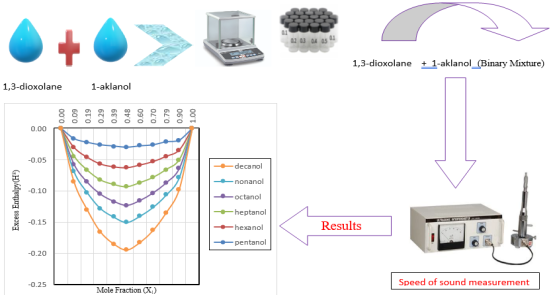
Scheme 1. Interactions between 1,3-dioxolane with 1-alkanols at 298.15K.
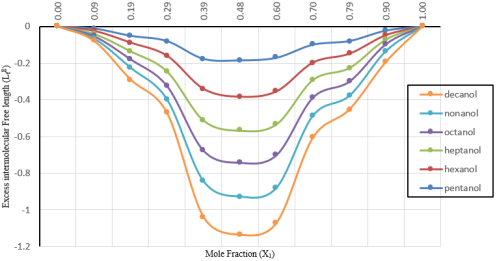
Figure 1. Variation of excess intermolecular free length () with mole fraction(x1) of 1,3-dioxolane with 1-alkanols at 298.15K.
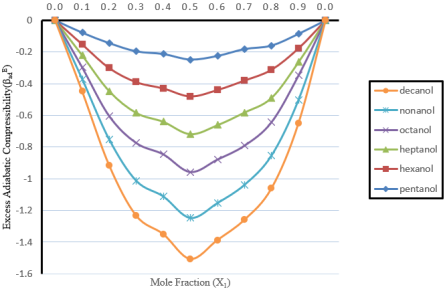
Figure 2. Variation of excess adiabatic compressibility () with mole fraction (x1) of 1,3-dioxolane with 1-alkanols at 298.15K.
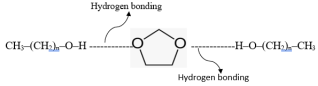
Figure 3. Hydrogen bonding present in 1,3-dioxolane– n-alkanols.
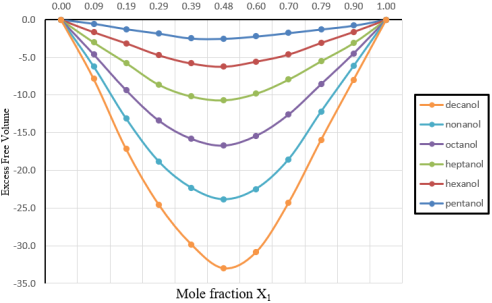
Figure 4. Variation of excess Free Volume with mole fraction(x1) of 1,3-dioxolane with 1-alkanols at 298.15K.
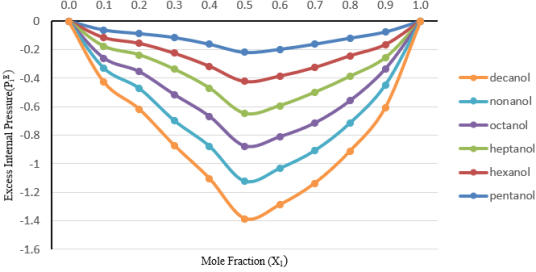
Figure 5. Variation of excess internal pressure with mole fraction(x1) of 1,3-dioxolane with 1-alkanols at 298.15K.
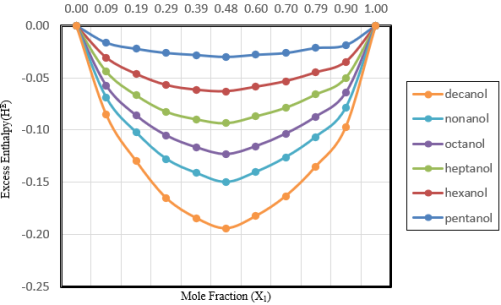
Figure 6. Variation of excess enthalpy (HE) with mole fraction(x1)of 1,3-dioxolane with 1-alkanols at 298.15K.
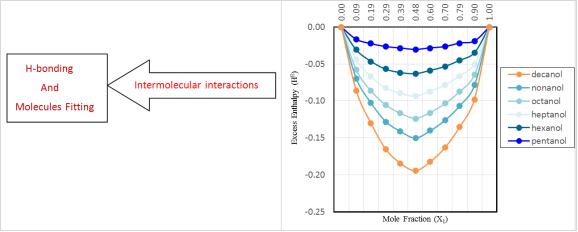
Figure 7. Show that Hydrogen bonding and Molecules fitting.




 Share This Article
 Twitter
 Linked In
 Facebook
 Copy
Copy Download